
Executive Summary
Pakistan Customs
Pakistan Customs plays a pivotal role as a geostrategic transit authority, overseeing trade flows into Afghanistan and Central Asia. To secure these high-stakes corridors, the department licensed three independent tracking companies to monitor all bonded carriers across all transit routes. While each vendor effectively tracked its assigned movements, their data remained siloed within separate systems—leaving Customs without a unified operational picture. This fragmentation created blind spots in command and control, limited centralized reporting, and made it difficult to apply advanced analytics or detect anomalies across the entire transit network
Discover How AI can Transform your Operations
The Challenge: Data Silos & Governance Gaps
While this solved the hardware and installation burden, it introduced new operational and governance challenges:
1. Siloed Monitoring with No Unified Visibility
Each tracking company operated its own platform, dashboards, and alerting systems. Customs officers were forced to switch between three separate systems just to obtain basic information such as trips, alerts, violations, and stoppages. There was no centralized command view to oversee the entire national transit ecosystem.
2. No Objective Oversight of Tracking Company Performance
3. No Accountability Framework for Mobile Enforcement Units (MEUs)
4. Blind Spots in Transporter & Driver Behavior
5. No Predictive Intelligence — and No Way to Unlock Its Benefits
Because telemetry data was scattered across multiple vendor systems, Pakistan Customs could not apply AI, ML, or predictive analytics at scale. This meant:
- No route-level risk prediction
- No detection of deviation hotspots or stoppage clusters
- No commodity-level vulnerability insights
- No data-driven scoring for drivers or transporters
More critically, Customs was unable to benefit from the positive capabilities
a centralized AI-driven system could deliver, such as:
- Trip-level AI summaries capturing anomalies, compliance issues, and risk indicators
- Performance scoring for tracking companies, benchmarked across consistent SLAs
- Operational scoring for MEUs based on alert quality, responsiveness, and resolution patterns
- Transporter and driver risk scoring , driven by historical behavior and violation trends
- Predictive alerts that identify high-risk trips before departure
- Dynamic risk heatmaps across the national transit network
In essence, Pakistan Customs was operating a high-stakes national transit operation through fragmented tools, manual oversight, and reactive workflows—with no unified intelligence or predictive capability to stay ahead of threats.
Discover How AI can Transform your Operations
The Solution: The Centralized Monitoring System (CMS)
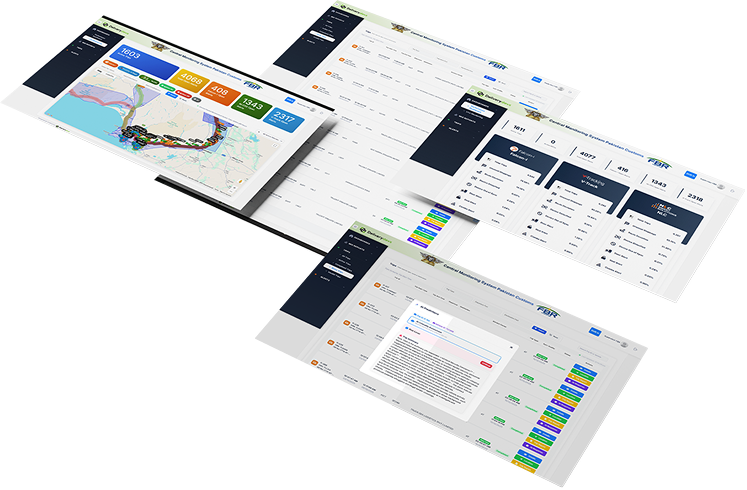
To bridge the gap between fragmented vendor data and effective Customs oversight, Deliverydevs engineered the Centralized Monitoring System (CMS). This software ecosystem serves as the “Intelligence Layer” that sits above the tracking vendors, aggregating their telemetry into a unified command view while enforcing strict operational accountability.
A. The Data Aggregation Ecosystem
- Container Visibility : Tracked via Hybrid Satellite/GSM devices.
- Truck Visibility: Tracked via GSM devices.
- Tamper Detection (LoRaWAN) : To ensure the prime mover stays with the cargo, the truck and container are linked via LoRaWAN. If this digital "handshake" breaks, the tracking company flags the event, and the CMS visualizes it immediately as a "De-Sync" alert.
B. The Alert Workflow & Visualization Engine
Deliverydevs designed a collaborative workflow that leverages the resources of the tracking companies while maintaining Customs’ supremacy as the regulator.
- When an event occurs (e.g., Route Deviation, Unusual Stoppage, or Door Open), the Tracking Company (Falcon-i, NLC, or V-Tracking) detects it first.
- The Tracking Company initiates the response protocol by contacting the driver and calling the relevant Mobile Enforcement Unit (MEU) for the sector.
- Geospatial Visualization: The CMS instantly plots the alert on the style="font-weight: 600;"> Designated GEO Map. This gives Customs officers a real-time visual of exactly where the violation is occurring, without needing to ask the vendor.
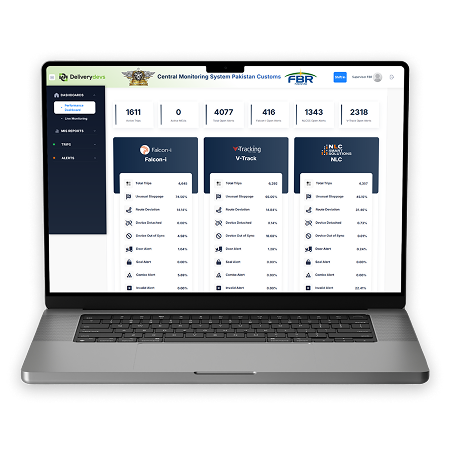
- Unified Dashboard: Instead of checking three different screens, Customs Supervisors see all active alerts from all three vendors on one map, color-coded by severity.
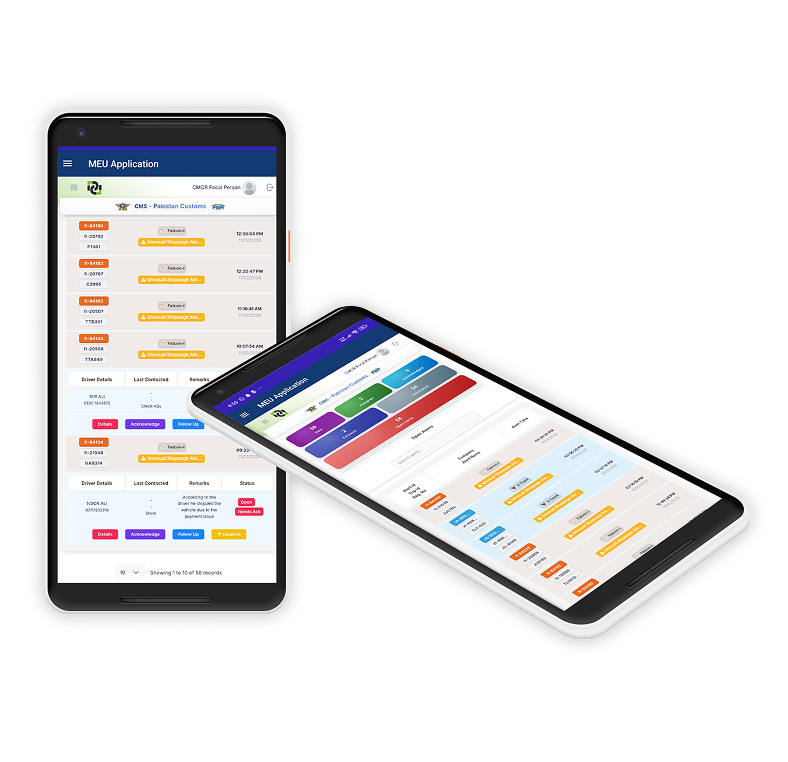
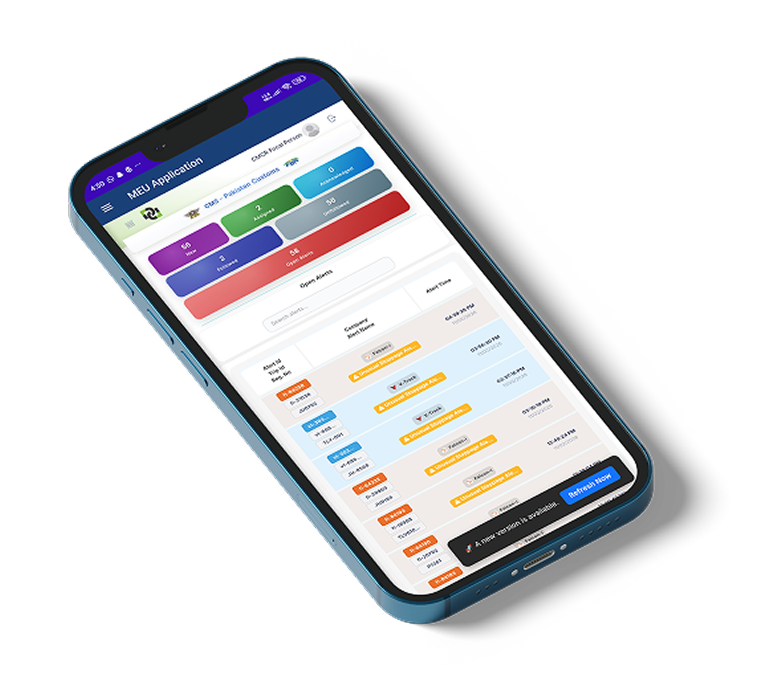
C. The "MeU App" & Accountability Framework
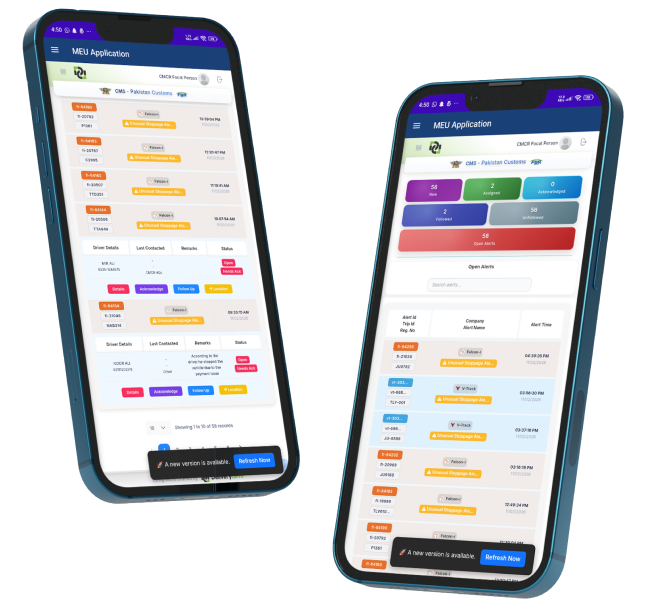
D. The "MeU App" & Accountability Framework
The Impact
Unified Command: A single authoritative interface for all national transit trade, eliminating the need to toggle between vendor systems.
Operational Clarity: The operational loop—where Vendors detect/dispatch and CMS visualizes/audits—ensures that no alert is ignored.
Data-Driven Governance: With AI-driven risk scoring and automated SLA tracking, Pakistan Customs has moved from reactive “firefighting” to proactive, intelligence-led enforcement.

 Development
Blueprint
Development
Blueprint