[ Casestudy]
Centralized Command & Control Platform for Pakistan Customs
From Data Silos to AI-Driven Enforcement: Securing the Geostrategic Corridors of Pakistan.
CLIENT
Pakistan Customs
Sector
Government
Scope
Centralized command platform
Data aggregation, alert workflow and AI risk scoring
services
AI SolutionsIoT Solutions
Mobile App Development, Web App Development
Contents
Copy link
01
The challenge
Pakistan Customs is a geostrategic transit authority overseeing trade flows into Afghanistan and Central Asia, and to secure those corridors it licensed three independent tracking companies to monitor bonded carriers. That solved the hardware and installation burden and created a governance problem in its place: a high-stakes national transit operation run through fragmented tools, manual oversight and reactive workflows, with no unified intelligence and no predictive capability to stay ahead of threats.
The governance gaps
- Siloed monitoring: each tracking company ran its own platform, dashboards and alerting, so officers switched between three systems for basic information on trips, alerts, violations and stoppages.
- No objective oversight of vendor performance: with vendors working in isolation, measuring how well each secured cargo, detected tampering or managed violations was subjective and fragmented.
- No accountability framework for Mobile Enforcement Units: no unified workflow for receiving, attending and closing alerts, and no reliable way to see whether teams responded on time or covered their jurisdictions.
- Blind spots in transporter and driver behavior: repeated unusual stoppages, route deviations and high-risk driving patterns could not be identified or correlated.
- No predictive intelligence: telemetry scattered across vendor systems meant no route-level risk prediction, no deviation hotspots, no commodity-level vulnerability insight and no data-driven scoring.
02
What we did
Deliverydevs engineered the Centralized Monitoring System, an intelligence layer that sits above the tracking vendors rather than replacing them. All licensed partners feed their telemetry into one platform, which creates a single source of truth: the trip lifecycle begins when a Goods Declaration is generated in WeBOC and pushed to the CMS with its assigned tracking company and transporter, and live telemetry is then aggregated — container visibility through hybrid satellite and GSM devices, truck visibility through GSM, and tamper detection over LoRaWAN, where truck and container are digitally linked so that a broken handshake surfaces as an alert the moment it happens.
Three vendors solved the hardware problem and created a governance one.
On the platform
03
The toolkit
Four layers carried the platform, each against a named part of the problem.
The data aggregation ecosystem
WeBOC integration initializes every trip from its Goods Declaration, and live telemetry from all three licensed vendors is ingested in one place — containers over hybrid satellite and GSM, trucks over GSM, and a LoRaWAN link between truck and container so a tamper event is visualized immediately rather than reported afterwards.
Alert workflow and visualization
A collaborative workflow that uses the tracking companies’ own resources while keeping Customs supreme as the regulator: the vendor detects the event and contacts the driver and the relevant Mobile Enforcement Unit, and simultaneously pushes the alert into the CMS, which plots it on the designated geo map so supervisors see every active alert from all three vendors on one screen, color-coded by severity.
The MeU App and accountability framework
The chain of custody digitized: an inspector directed to a site must confirm arrival in the app, cannot close an alert verbally but has to upload geo-tagged photographs of the truck and container seals, and the CMS measures the time from alert generation to digital confirmation — turning field response into an objective performance score.
The AI prediction engine
A proprietary machine learning engine that turns raw telemetry into strategy: predictive route risk scoring with dynamic heatmaps of deviation hotspots and dark zones where signal is frequently lost, transporter and driver profiling that assigns risk scores from historical behavior so high-risk entities can be flagged before they are assigned, and automated scorecards benchmarking each tracking company on data accuracy, response time and equipment reliability.
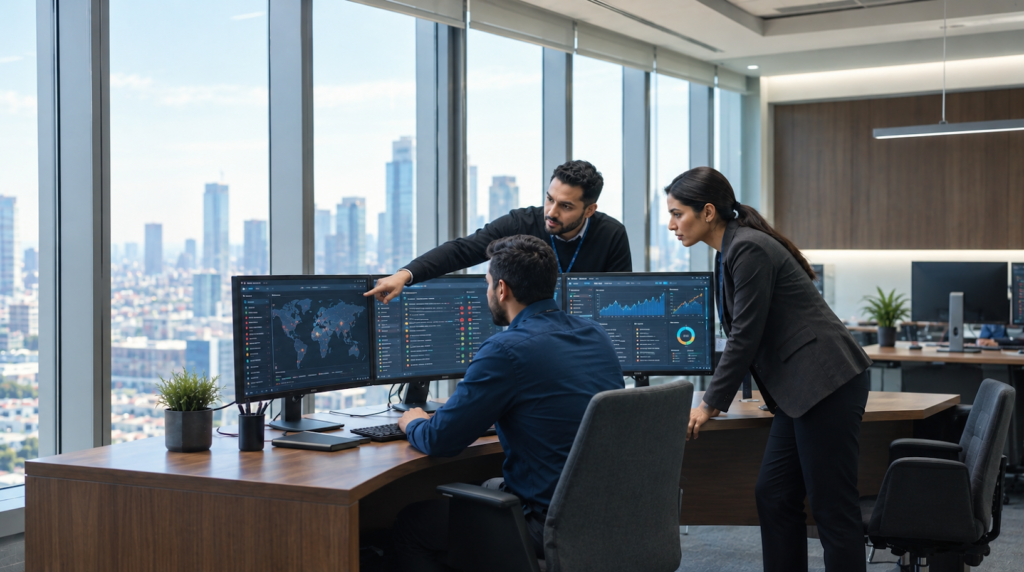
Centralized command platform
Discover how AI can transform your operations
Tell us where your data is fragmented and we’ll show you what a single picture would look like.
04
Results
The platform gives Pakistan Customs a single authoritative interface for all national transit trade, with no need to toggle between vendor systems. The operational loop — vendors detect and dispatch, the CMS visualizes and audits — means no alert goes unaccounted for. And with AI-driven risk scoring and automated SLA tracking, the department has moved from reactive firefighting to proactive, intelligence-led enforcement.
05
Conclusion
The decision to license three independent tracking companies was sound; what it lacked was a layer above them. Building that intelligence layer rather than a fourth tracking system is what turned three vendors’ data into one operating picture — and what made objective oversight of the vendors themselves possible for the first time.
Running oversight across systems you don’t control?
Send us the setup and an engineer will come back with how an intelligence layer would fit.
