
Overview
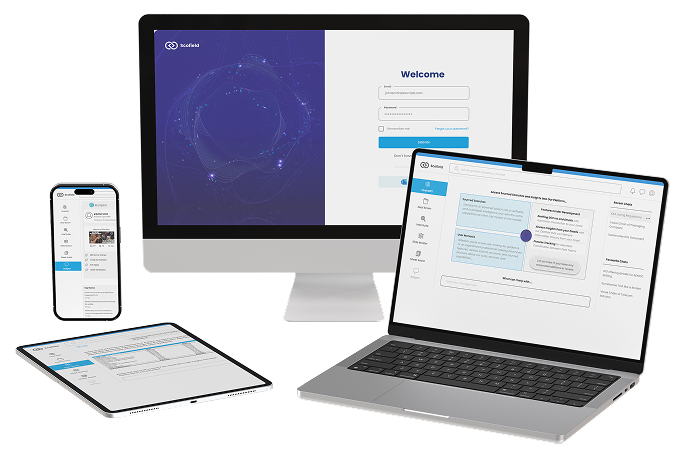
A UK-based fintech innovator identified a structural gap in how finance professionals and consultants do their daily work. The tools they relied on; Excel models, PowerPoint decks, dense PDF research, fragmented email threads were powerful individually but disconnected, manual-heavy, and increasingly misaligned with the pace of modern deal-making and analysis.
Their vision:
a single, intelligent platform that would give finance professionals an AI co-pilot for research, a smart deal document hub, and automated slide-building engine tools purpose-built for the way finance teams actually operate.
The vision was clear. Execution required a partner who could think in product terms, operate across the full stack, and move fast without cutting corners.
Deliverydevs stepped in not just as a development house, but as an embedded technical and product partner to design, architect, and build the platform from the ground up.
The Opportunity & The Challenge
The gap they identified was specific:
• Finance professionals needed a conversational AI that understood financial language and could interact with their own documents, not a generic chatbot.
• Slide-building remained a time-intensive craft: manually pulling data from backups, selecting templates, formatting figures, and checking for errors.
• There was no structured, intelligent way to store, tag, search, and retrieve documents across different file formats and contexts.
• Email and calendar workflows remained entirely separate from the analytical workspace; creating constant context-switching.
Translating that insight into a shippable product meant solving a complex set of technical and design challenges:
• Architecting a multi-module platform where AI was not bolted on, but native to every workflow.
• Designing LLM integrations capable of handling proprietary financial documents via a retrieval-augmented generation (RAG) system.
• Building a Slide Master engine that could generate and validate PowerPoint outputs programmatically from raw financial data.
• Establishing the cloud infrastructure, CI/CD pipelines, and security posture required for a platform handling sensitive client data.
The client came to Deliverydevs to close the gap between a compelling market insight and a
fully realised, deployable product.
Every feature on the roadmap had a finance professional at the centre — and a technical decision behind it.
Our Solution: Full-Stack Product Partnership
Deliverydevs deployed a cross-functional squad embedded directly into the client’s product workflow covering product design, frontend and backend engineering, AI/ML integration, DevOps, QA and cybersecurity. Rather than handing off deliverables, the team operated as an extension of the founding team: aligning on requirements, challenging assumptions, and executing across every layer of the stack.
The Squad
• Frontend Developer — React.js, Material-UI, Office.js (PowerPoint Add-in)
• Backend Developer — Python, FastAPI, LLM orchestration, API architecture
• UI/UX Designer — Figma-based product design, finance-specific UX patterns
• Senior QA Engineer — end-to-end test coverage, release validation
• DevOps Engineer — AWS provisioning, CI/CD pipeline, monitoring
• Cybersecurity Specialist — data security, OAuth 2.0 compliance, vulnerability audits
Before any line of production code was written, the team ran a structured discovery and proof-of-concept phase to validate the architecture, confirm the AI integration approach, and align on the tech stack ensuring no expensive rework down the line.
Strategic Execution Areas
1. Platform Architecture & System Design
Deliverydevs led the end-to-end architecture design for a modular,
AI-native platform. The system was structured around three core beta modules with clear API boundaries that would allow each to scale independently and new modules to be added without structural rework.
The backend was built on Python with Fast API, chosen for its sync performance and clean integration with the AI and data-processing libraries central to the platform. A PostgreSQL database handled metadata and user session storage, while AWS S3 provided the secure, scalable document storage layer underpinning the Intelligent Document Management Module. Elasticsearch powered fast, tag-based document retrieval across multiple file types.
Every architectural decision was made with scale in mind — both the scale of data (financial documents of varied types and sizes) and the scale of users (a growing professional user base with enterprise-grade expectations).
Platform Architecture is a product decision. We treated every technical choice as one with a user experience
consequence.
2. LLM Integration & Financial Intelligence
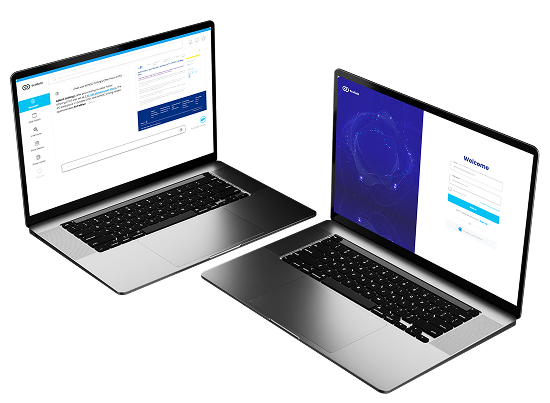
The system was built to support multiple LLM backends, with GPT-4 as the primary engine and architecture in place to plug in finance-tuned models such as Palmyra Fin for enhanced domain accuracy. Email and calendar integration via Microsoft Graph API and Google Workspace API allowed users to draft communications and schedule meetings without leaving the platform collapsing a critical workflow gap.
Every user interaction with the Co-Pilot was logged for future feedback loops and model fine-tuning, ensuring the platform would grow smarter with usage.
The Co-Pilot was not built to replace the analyst. It was built to eliminate the hours they spend on tasks that don’t require their expertise.
3. Intelligent Document Management
Finance teams accumulate vast quantities of documents, models, decks, research reports, term sheets often stored in ways that make retrieval slow and contextual search impossible.
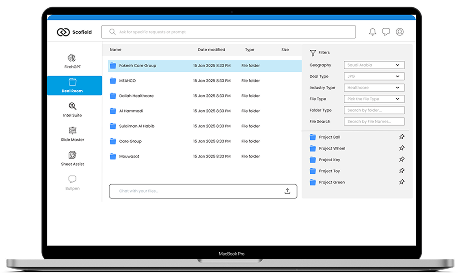
It was built to change that. Deliverydevs designed a structured document management system where every file uploaded to the platform whether manually or automatically from the Ai based LLM module interactions was parsed, indexed, and tagged. Documents were understood, not just stored
Metadata tagging covered file type, geography, deal type, date range, and content classification. Users could filter across their document library with precision, and any document could be surfaced directly into a conversation. The React.js frontend delivered a clean, drag-and-drop interface that felt intuitive to finance professionals accustomed to structured data environments.
Document parsing used PyPDF2 for PDF extraction and OpenAI’s API for intelligent summarisation giving every document in the vault a machine-readable identity.
6. DevOps, Cloud Infrastructure & Security
The platform was provisioned on AWS with a fully automated CI/CD pipeline, enabling rapid, low-risk feature releases throughout the development cycle. Infrastructure monitoring ensured reliability, and deployment workflows were structured to support both the beta release and future scale.
Security was not a post-launch consideration. Given that the platform would handle sensitive client financial data, Deliverydevs embedded a cybersecurity specialist from day one. Encryption protocols were applied to data at rest and in transit. OAuth 2.0 authentication governed all user and integration access. Vulnerability assessments were conducted proactively, and the architecture was aligned with financial data handling best practices.
User interaction caching built into the system from the start, provided the data foundation for future model training and product feedback loops, while maintaining appropriate data governance standards.
5. UI/UX Design: Built for Finance Professionals
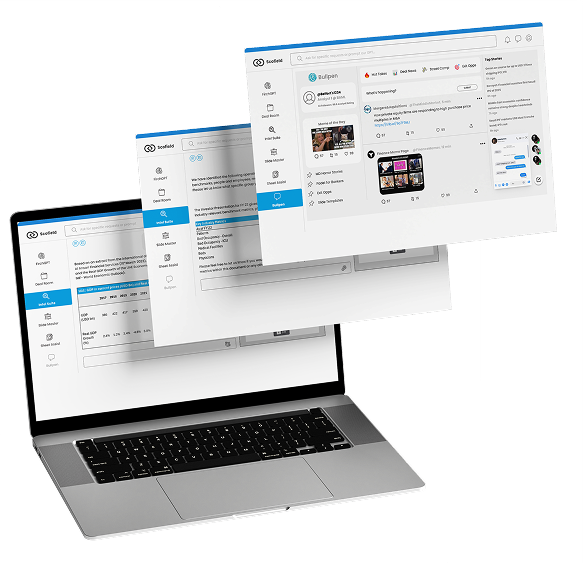
Finance professionals are precise, workflow-oriented, and quick to dismiss tools that feel underdeveloped. In this module, the design challenge extended beyond aesthetics; it was about enabling seamless transformation of complex financial data into structured, presentation-ready outputs.
Deliverydevs’ UI/UX designer worked in Figma to craft a clean, information-dense interface tailored to the realities of financial modeling and comps analysis. The experience was designed to guide users from raw source documents such as financial models and comparable company files into organized backups and polished visual outputs through intuitive templates and guided prompts.
Structured layouts, clear data hierarchies, and logical step-by-step flows ensured minimal friction between input and outcome. Special attention was given to template-driven workflows, allowing users to quickly generate fully linked financial model skeletons based on client financial statements reducing manual effort while maintaining analytical integrity.
Material-UI components provided a production-ready foundation, which the team customized to reflect financial workflows and data-heavy interactions. The result is an interface that feels purpose-built for finance professionals supporting both precision work and efficient output creation, rather than relying on generic SaaS design patterns.
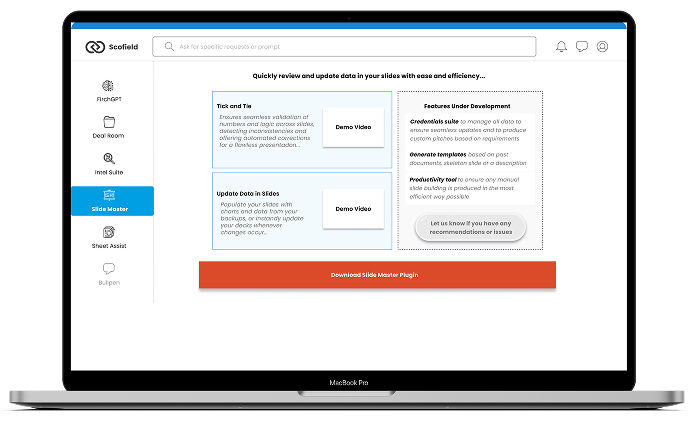
4. AI-Powered Presentation Automation
This was the most technically ambitious module and the one with the clearest ROI for the target user.
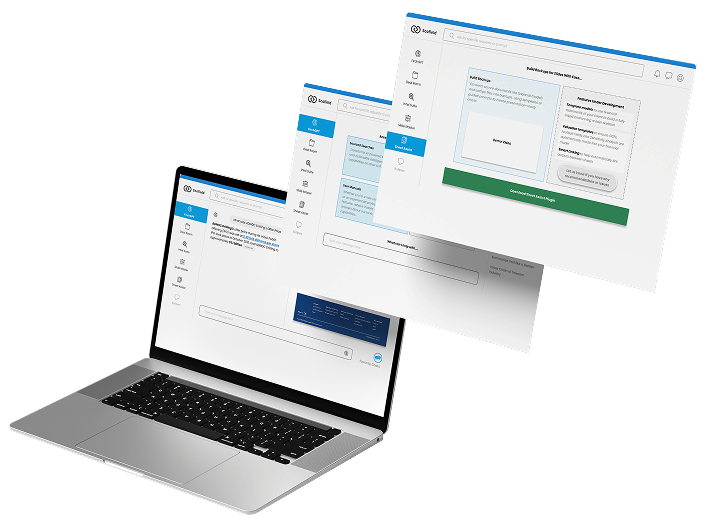
It was built around three sub-functions
Backup Generator
Users provide source documents; raw Excel files or PDFs along with structured requirements (e.g., Revenue, Gross Profit, EBITDA, 2022–2024). The system extracts the relevant data using Pandas and PyPDF2, then programmatically constructs a clean Excel backup ready for use in PowerPoint. Two sample backup types were implemented: data pulled from external sources, and backups built from within the same workbook.
Template Generator
Rather than presenting a static template library, the system dynamically recommends PowerPoint templates based on the user’s slide intent (e.g., a four-metric summary slide vs. a six-person team introduction). The engine built with python-pptx and guided by GPT-4 could also learn from templates uploaded to the generator, expanding its recommendation set with the client’s own design language. Users retain full control: their backups with our templates, our backups with their templates, or a straight values-update on an existing deck.
Tick and Tie Assistant
A dedicated error-checking agent reviews completed slide decks for internal inconsistencies flagging instances where the same figure is referenced differently across slides, or where values do not reconcile. This feature addressed one of the most time-consuming and error-prone tasks in investment banking and consulting deliverables.
The Module was architected as a Microsoft PowerPoint Add-in using the Office.js SDK, allowing users to engage with the AI tooling directly inside the applications they already work in — lowering the adoption barrier significantly.
The Presentation Automation Module alone had the potential to recover hours of analyst time per deck. That was the benchmark we designed.
A Performance-Aligned Engagement
This engagement was executed under a team augmentation model, with Deliverydevs embedding a dedicated team that operated as a true extension of the client’s internal function. From the outset, the focus was on continuity, collaboration, and ownership ensuring that our team integrated seamlessly into existing workflows, communication channels, and decision-making processes.
Rather than functioning as an external vendor, the Deliverydevs team aligned closely with the client’s product vision and day-to-day operations. This enabled faster iterations, clearer communication, and a deeper understanding of both technical and business requirements. Our team remained actively involved across the entire lifecycle from initial planning and design to development, refinement, and final delivery.
A strong sense of accountability defined the engagement. Deliverydevs took full ownership of deliverables, proactively addressing challenges, maintaining momentum, and ensuring that timelines and quality benchmarks were consistently met. The result was a highly collaborative environment where both teams worked in sync, driving the project forward with shared clarity and purpose.
This approach reflects Deliverydevs’ strength in team augmentation bringing not just technical expertise, but commitment, reliability, and a partnership mindset that enables clients to scale effectively and deliver with confidence.
The Outcome
Through end-to-end ownership of design, engineering, and infrastructure, the client achieved:
• A fully designed and developed beta platform delivered on an accelerated timeline.
• A financially-aware AI powered presentation automation with RAG-based document interaction, email integration, and multi-LLM architecture.
• An intelligent document management system capable of parsing, tagging, and making searchable every deal document in the user’s vault.
• An AI-powered slide generation and error-checking engine that materially reduced manual presentation workflow time.
• A scalable, secure cloud infrastructure with continuous deployment capability and embedded cybersecurity posture.
• A complete, production-grade UI/UX design aligned to the workflows and expectations of finance professionals.
The client retained full strategic control of the product roadmap while DeliveryDevs delivered the full technical depth and execution rigour required to bring it to market.
The beta was not just a proof of concept. It was a fully operable product,
ready for users, ready for feedback, and ready to scale.
Discover How AI can Transform your Operations
Why This Matters
Building an AI-native product for financial professionals is an order of magnitude more complex than building a general-purpose tool. The data is sensitive. The workflows are precise. The users are demanding. The stakes — in deal accuracy, client trust, and regulatory alignment — are high.
Delivering it requires more than engineering capacity. It requires:
• Product thinking that starts with the user’s workflow, not the technology
• AI integration expertise that goes beyond API calls to real RAG pipelines and fine-tuning readiness
• Full-stack ownership across frontend, backend, design, DevOps, QA, and security
• Architectural foresight that makes scaling from beta to enterprise a refinement, not a rebuild
• A partnership model that aligns the team’s incentives with the client’s commercial success
Deliverydevs delivered all of it — and the platform stands as proof that when the right technical partner is embedded at the right moment, vision becomes a product.

 Development
Blueprint
Development
Blueprint